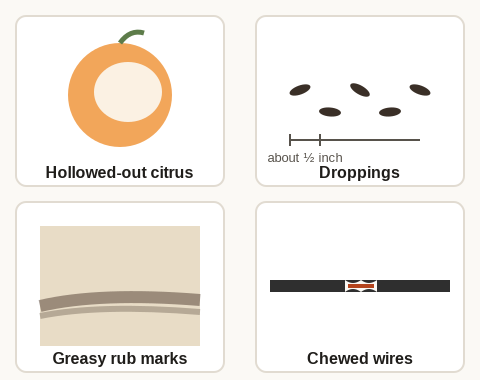
The most common signs are scratching in the attic or walls at night, citrus hollowed out while it's still on the tree, droppings about half an inch long, greasy rub marks along walls and beams, and chewed wires. If you have two or more, assume roof rats and act before they nest.
What to look and listen for
- Noises at night in the attic, ceiling or walls. Roof rats are active after dark and quiet by day.
- Hollowed-out fruit. They eat citrus from the inside and leave the empty rind hanging on the tree or on the ground.
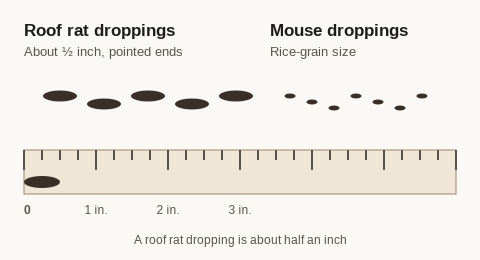
- Droppings that are elongated with tapered ends, in the attic, garage, along walls or under sinks.
- Greasy rub marks where their bodies brush the same path again and again.
- Gnaw marks on wiring, pipes, insulation, wood, and around roof eaves.
- Sightings at dusk on power lines, trees, fences, patios and roofs.
- Pets acting unsettled, staring at walls or ceilings at night.
Roof rats or mice?
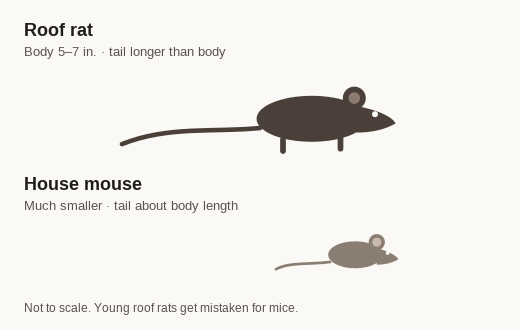
An adult roof rat is slender, dark brown to black, with large ears and a tail longer than its body. Young roof rats get mistaken for house mice. Droppings help: roof rat droppings are about half an inch long, much bigger than a mouse's. Either way, the fix starts the same: find and seal the openings.
Questions
Can you have roof rats and never see one?
Yes. They avoid light and are seldom seen during the day. Most people find the signs first: noises at night, hollowed fruit or droppings.
Where do roof rats nest in a house?
Most often in attics and wall voids. They use the attic as a safe place to nest and as a route into the rooms below.
Do roof rats come inside the house?
They can. They follow pipes down from the attic and can gnaw through drywall into kitchen and sink cabinets.
Sources
- University of Arizona Cooperative Extension, How to Identify and Discourage Roof Rats (2024)
- Maricopa County Vector Control, Roof Rats FAQ
- University of Arizona, Roof Rats: Identification, Ecology, and Signs (AZ1775)
Checked 2026-11-24. Rules and amounts change, so confirm with the agency before you rely on them.