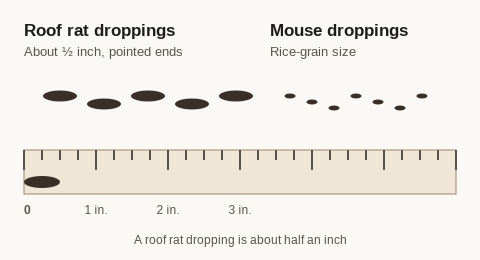
Roof rats are bigger, with a tail longer than their body, and they live up high: attics, trees, roofs. Mice are small, live closer to the ground, and leave much smaller droppings. Droppings about half an inch long point to rats.
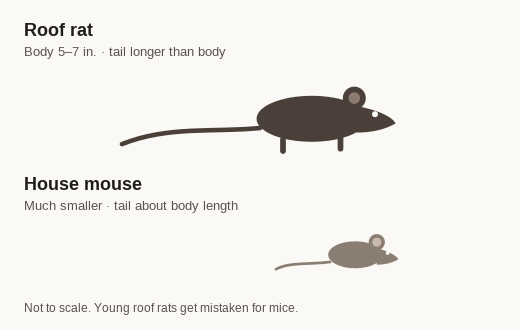
| Roof rat | House mouse | |
|---|---|---|
| Adult body | About 5–7 in. | Much smaller |
| Tail | Longer than head and body | About as long as the body |
| Droppings | About ½ in., pointed ends | Tiny, rice-grain size |
| Where you hear them | Attic, ceiling, roofline | Walls, cabinets, floor level |
| Outdoor sign | Hollowed-out citrus on the tree | Rarely in trees |
Why it matters
Roof rats come in high: over branches, power lines and the roof. So the fix focuses on the roofline, vents, plumbing stacks and tile edges, not just the doors and the bottoms of walls.
Not sure? Take the roof rat check
Questions
Could a small rodent be a young roof rat?
Yes. The University of Arizona notes young roof rats are often confused with house mice.
Do the same traps work for both?
Rats need bigger rat-size snap traps. Mouse traps are too small to work well on rats.
Sources
- University of Arizona Cooperative Extension, How to Identify and Discourage Roof Rats (2024)
- University of Arizona, Roof Rats: Identification, Ecology, and Signs (AZ1775)
Checked 2026-11-24. Rules and amounts change, so confirm with the agency before you rely on them.